Open-Source LLM Builders Summit
Blueprints for Global Collaboration
September 30, 2026
We share progress, explore new partnerships and discuss a shared blueprint for developing, financing and deploying the next generation of open foundation models.
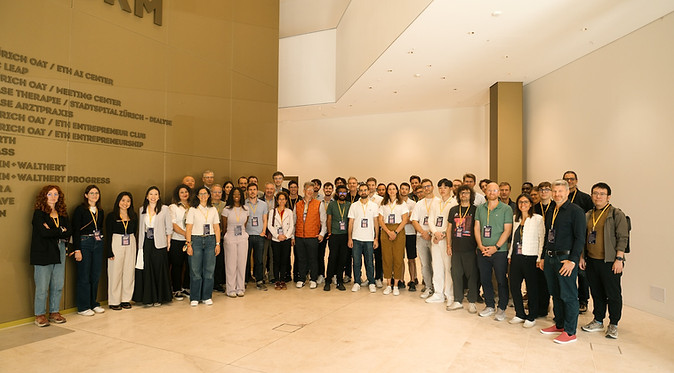
On 30 September 2026, a workshop gathered international champions of open source LLM development at the ETH AI Center in Zurich. Organized with the EPFL AI Center on behalf of the Swiss AI Initiative, as part of the week-long Zurich AI Festival and just ahead of its flagship AI+X Summit.
The Builders Summit built on two previous gatherings, held in Geneva in July 2025 and Lausanne in February 2026, which had helped the international open AI community exchange achievements and identify opportunities for collaboration. The third edition (event page) was moderated by Arnout Devos (AI for Science program lead), and set an ambitious objective: to move towards a major international collaborative initiative, supported by a sustainable funding model.
Three goals shaped the programme:
1) sharing progress from leading open-source and open-weight model initiatives;
2) enabling concrete international collaborations, incl. access to computing resources;
3) exploring what it would take to define and finance a shared flagship project.
These questions set the stage for the afternoon discussions, in which participants explored four interconnected dimensions of global collaboration: a shared flagship project, computing infrastructure, financing and sustainability, and adoption and impact.
Keynotes
Andreas Krause — ETH AI Center, ETH Zurich
Professor Krause, Chair of the ETH AI Center Steering Committee, opened the Summit by welcoming the international community of open AI builders to Zurich. As ETH Zurich's interdisciplinary hub for artificial intelligence, the AI Center was a natural host for an event dedicated to advancing trustworthy, inclusive and accessible AI through collaboration.
Martin Jaggi — Apertus, EPFL
Prof. Martin Jaggi, co-lead of the Apertus project and head of the Machine Learning and Optimization Laboratory at EPFL, highlighted the growing demand for trustworthy open models. He described this demand as an encouraging signal from the open-source developer community and traced the evolution of Apertus from its initial release in September 2025 to Apertus 1.5 in July 2026. He also presented the ambitions for Apertus 2, including a new Mixture-of-Experts architecture designed to support considerably larger models. Developed through a collaboration between ETH Zurich, EPFL and the Swiss National Supercomputing Centre (CSCS), Apertus had demonstrated the potential of combining academic research, national computing infrastructure and open development practices. Prof. Jaggi invited further community contributions across pretraining, post-training, infrastructure, data, environments, evaluation, safety and alignment, emphasizing that the next generation of open models would depend on broader international participation.
[2026] Open Model Builders event intro.pdf
Jeff Hammerbacher — Open Athena & Marin
The founder and CEO of Open Athena, explored how more rigorous scientific methods make open foundation model development more predictable and sustainable. Drawing on the principles guiding Open Athena and its collaboration with Stanford University's Marin project, he emphasized the importance of using scaling laws to anticipate model performance and estimate the expected return on computational investment. Such predictions could strengthen confidence among funders and help research teams learn more effectively from expensive training experiments. Hammerbacher encouraged systematic data collection, independence from individual API providers and training hardware, and transparency throughout the development pipeline. His presentation highlighted how reproducibility and robust scientific methods could help make ambitious open model programmes credible, efficient and resilient.
Open-Source Initiatives
Wai Yi Leong — SEA-LION, AI Singapore
A researcher involved in AI Singapore's SEA-LION initiative emphasized that model development needed to account for cultural context as well as technical performance. Their group has developed open models designed to better represent the languages, cultures and knowledge of Southeast Asia. Leong guided participants through the development pipeline behind SEA-LION 4.8, illustrating the considerations involved in building and adapting models for regional needs. Her presentation also raised questions about the future of reinforcement learning, including whether AI agents could generate their own training environments or sandboxes. The project demonstrated how regional model development could benefit from global open-source foundations while addressing requirements that might otherwise remain underserved.
SEA-LION v4.8 3rd Open LLM Builders Summit.pdf
Ahmad Chamma — K2 Horizon, MBZUAI
A researcher at the Institute of Foundation Models at Mohamed bin Zayed University of Artificial Intelligence (MBZUAI), shared insights from the K2 Horizon initiative. The institute had demonstrated rapid progress in foundation model research, with seven high-performing model releases at different scales and computational requirements highlighted during the Summit, contributing to a growing international ecosystem of research-driven foundation models. Chamma's presentation provided insights into the technical and organizational efforts behind this development, demonstrating the increasing geographical diversity of advanced foundation model research and the potential for cooperation between institutions pursuing similar technical ambitions.
Matthias Bethge — OpenEuroLLM
Professor at the University of Tübingen and a researcher associated with OpenEuroLLM, represented a coordinated European effort to develop transparent, multilingual foundation models. OpenEuroLLM has brought together research institutions, companies and computing facilities across Europe to strengthen technological independence and support diverse linguistic requirements. Bethge emphasized that commitments to transparency needed to be backed by documentation, reproducible research practices and appropriate recognition of the work on which new models depended. He also highlighted the importance of diversity in AI development rather than assuming that progress needed to follow one predetermined technological path. His contribution reinforced the need for shared standards and closer cooperation between research groups while preserving the flexibility and creativity of the open-source community.
Jenia Jitsev — LAION
The co-founder and scientific lead of LAION and a researcher at the Jülich Supercomputing Centre, examined approaches to building and maintaining competitive open AI systems. LAION had contributed major open datasets and research tools, including LAION-5B and OpenCLIP, which had supported advances in multimodal machine learning. Jitsev discussed strategies ranging from predicting training loss and optimizing hyperparameters to identifying problems in training data mixtures. Examples of issues uncovered through community participation demonstrated how openness could directly improve the scientific quality of AI development. His presentation illustrated that transparent pipelines were not merely a principle of open research, but also a practical advantage that enabled scrutiny, error detection and continuous improvement.
Joshua Tan — Current AI
The Chief Technology Officer of a “global partnership building a public option for AI”, addressed the challenge of transforming open foundation models into competitive, accessible products. This international initiative connects researchers, governments, philanthropic organizations and open-source developers around the development of public-interest AI technology. Tan explored what it would take to build viable alternatives to commercial product suites using foundations such as Apertus. His presentation examined the different layers of the technology stack, from models and infrastructure to applications and user-facing services. He emphasized the opportunities for collaboration between projects that contributed different components of this ecosystem. The session raised a central question for the Summit: how could the open AI community translate shared research achievements into integrated products that people and organizations could deploy and use?
Open-Weight Initiatives
Meriem Bendris — NVIDIA Nemotron
A senior deep learning data scientist at NVIDIA presented the Nemotron family of open models and the associated datasets, training techniques and development tools. The Nemotron initiative had made capabilities available for reasoning, conversational applications and agentic AI systems, alongside resources designed to support customization and deployment. Bendris explained key elements of NVIDIA's broader offering and illustrated model capabilities through performance comparisons. Her presentation contributed an industry perspective to the discussion of open AI, highlighting the interplay between model architectures, specialized hardware, development tools and efficient inference.
NVIDIA Nemotron3 - Open LLM builders Summit - Zurich - 2026.pdf
Calls for Collaborative Projects
Joost VandeVondele — CSCS
The Deputy Director for Science at the Swiss National Supercomputing Centre, presented the computing infrastructure needed to support increasingly demanding AI research, in a talk that addressed the challenges of providing computational resources for training, evaluation and inference, as well as the opportunities for collaboration through major computing facilities. His contribution highlighted that making AI models openly available was only one part of ensuring broad access to advanced AI capabilities. The infrastructure required to train, evaluate and operate such models also needed to be considered. VandeVondele subsequently led the breakout discussion on computing and infrastructure, where participants explored how resources and expertise might be shared across institutions and borders.
ML_at_CSCS_VandeVondele_LLM_Summit_Sept_2026.pptx.pdf
Timothy Llewellynn — Euresearch / EuroHPC
Our National Contact Point for Digital at Euresearch, presented opportunities for researchers and other eligible organizations to access advanced computing resources through European programmes. His session focused on EuroHPC AI Factories and related access calls, explaining potential pathways for collaborative AI research and development. These facilities had been established to support a wider range of organizations with computing capacity and associated services. The presentation complemented the CSCS perspective by highlighting mechanisms through which international teams could seek the resources required for ambitious AI initiatives.
20260930_Euresearch_EuroHPCJU_AIFactories_Collaboration.pdf
Birds of a Feather Sessions
Following the technical presentations and a poster session, participants moved into four parallel Birds-of-a-Feather discussions. Each group examined a different component of a potential international collaboration, guided by questions designed to move from general ambitions towards actionable proposals. The discussions considered what the community might build together, how shared computing infrastructure could operate, how open development might be financed, and what would be required to achieve meaningful adoption.
1. A shared flagship: Agreeing on what to build together
Led by Martin Jaggi, the first discussion addressed the possibility of establishing an international flagship project that no single research initiative could deliver alone.
Participants identified collaboration on data as one of the strongest opportunities for the open AI community. Beyond sharing datasets and technical resources, they discussed the need to communicate more consistently with regulators and provide concrete examples of best practices concerning data compliance, copyright and other regulatory questions affecting open model builders.
Another important theme was how to coordinate technical development without creating unnecessary bureaucracy. Participants emphasized the value of making decisions about what to train based on scientific evidence and establishing clear, shared metrics for evaluating progress. Such metrics could make competition for limited computational resources more transparent and provide funders with a stronger rationale for supporting international projects.
The discussion also explored different organizational approaches, contrasting small, agile research teams with large consortia and committees. One proposed model drew inspiration from competitive research funding approaches in which multiple teams initially worked on smaller models, and the most promising results received additional computing resources.
Rather than prescribing a single organizational structure, the discussion suggested that a compelling international flagship could emerge from shared datasets, evidence-based research decisions and transparent evaluation, supported by coordination that preserved the agility of individual teams.
2. Compute and infrastructure: Connecting resources across borders
The second discussion, led by Joost VandeVondele, examined how international teams could obtain and coordinate the computing resources required for large-scale AI development.
Participants discussed opportunities through Swiss national computing calls, EuroHPC programmes, public-private partnerships and other resource procurement mechanisms. They also considered how compelling scientific objectives and clear evidence of impact could strengthen applications for major computing allocations.
Looking beyond traditional pretraining, the group identified emerging infrastructure needs for reinforcement learning, agentic systems, inference and laboratory automation. These applications introduced new technical and operational requirements, including reliable services, uptime guarantees and predictable response times. Participants also discussed how computing facilities could function as testbeds for emerging hardware, drawing parallels with models of collaboration involving industry and major scientific laboratories such as CERN.
A central challenge was how to connect infrastructure distributed across institutions and countries. Possibilities included conducting pretraining at one major facility while distributing experiments and specialized expertise across regional partners, or connecting inference services through coordinated discovery and routing mechanisms.
The group highlighted substantial practical barriers, particularly moving and managing large multimodal datasets, maintaining data provenance and versioning, ensuring code portability and sustaining shared software workflows. The long-term maintenance of infrastructure would therefore require investment not only in hardware, but also in engineering, tooling and operational support.
The discussion demonstrated that a global collaboration would need more than access to individual compute resources: it would also require interoperable infrastructure, portable research workflows and reliable mechanisms for sharing computational capabilities.
3. Financing and sustainability: Who pays, and why?
The third breakout discussion, led by Oleg Lavrovsky, examined the financial foundations of a sustainable open AI ecosystem.
Participants noted that calculating the annual cost of training and maintaining open foundation models was considerably more complex than estimating the expense of a single training run. Costs depended on factors such as the number of training tokens, energy prices, relationships with computing providers and actual GPU utilization. Research programmes also incurred costs across successive experiments, post-training, evaluation, deployment and ongoing development.
The group explored several possible financing mechanisms, including nonprofit grants, service contracts for high-performance computing expertise, mechanisms for capturing a share of the value generated by open AI, and dual-licensing approaches for datasets that could support revenue generation while keeping model weights openly available. Industry partnerships presented further opportunities and tensions. Participants discussed how organizations could contribute expertise, data and financial resources without undermining open-source principles, confidentiality or ownership requirements. This was particularly relevant for sectors such as finance, where valuable datasets could not necessarily be shared openly.
A recurring theme was that training increasingly capable models could not, by itself, ensure long-term sustainability. Financing needed to support the broader ecosystem, including post-training, deployment and the applications through which models created real-world value. Discussions also considered evolving regulation, low-resource languages and stronger cooperation between researchers, governments and industry.
The emerging message was that sustainable open development would require diversified financing and clearer evidence of the value created by the entire ecosystem, rather than funding successive model releases in isolation.
4. Adoption and impact: Making open AI work in practice
The fourth discussion, led by Imanol Schlag, focused on the gap between making powerful models available and enabling organizations to use them effectively.
Participants described practical barriers to adoption, including missing deployment tools, limited support for platforms such as mobile devices and difficulties setting up local models in institutional environments. Examples from international organizations and users of Nemotron illustrated how model availability did not automatically translate into straightforward deployment.
The discussion also considered the needs of regional-language users and smaller organizations. In the case of SEA-LION, potential applications included organizations working with customer data, businesses needing to respond quickly in local languages and small and medium-sized enterprises for which the cost of deployment could remain prohibitive.
Participants emphasized that the limited number of real-world users made it harder to identify where models failed. They highlighted the importance of evaluation tailored to particular domains and organizations, including applications involving sensitive information. Retrieval and search capabilities were identified as particularly relevant for applications such as clinical information systems.
To demonstrate impact, the group called for more successful real-world deployments, stronger evidence of adoption by companies and public institutions, and clearer examples of social value. It also encouraged developers to use their own models more extensively, operate their own inference services and improve the cost of serving models.
As software engineering agents and increasingly autonomous workflows opened new possibilities, participants argued that open AI initiatives needed to pay closer attention to usability, integration and the full cost of deployment.
The discussion reinforced a central lesson: the success of open collaboration in AI would ultimately depend not only on benchmark performance, but on whether people and organizations could deploy these systems, trust their results and obtain meaningful value from them.
Blueprints for Global Collaboration
A successful international flagship would need a clear scientific direction and shared evaluation criteria. Its participants would require access to computing resources and infrastructure that could support research across institutions and regions. Sustainable financing would need to account for the entire development lifecycle, while adoption would provide the real-world evidence necessary to demonstrate the project's value.
Several ideas connected the discussions: shared evaluation metrics could make computing allocations more transparent and research investments easier to justify. Coordinated datasets and common technical infrastructure could reduce duplication between research initiatives. Practical deployments could provide feedback for post-training and evaluation, while helping demonstrate impact to potential funders and partners.
These connections provided the basis for the Summit's final plenary, where participants had the opportunity to consider how the proposals might contribute to a larger international undertaking.
The third Open LLM Builders Summit demonstrated how far the open ecosystem had progressed, from individual model releases towards increasingly coordinated research, infrastructure and technology development. The discussion outcomes outlined a set of practical priorities and possible approaches on which further cooperation could build. The challenge ahead remains to connect these elements into collaborations capable of producing results that no single organization could achieve alone.
Thanks to all who support our Summit by taking these discussions and presentations further in the future.